Every year, tens of thousands of top students apply to the UK’s most prestigious universities, but only a select few receive offers from the G5: Oxford, Cambridge, LSE, Imperial College London, and UCL. Top grades alone are not enough.
The G5 evaluates more than transcripts. They look for depth, originality, and intellectual maturity qualities that require years of strategic preparation, not months of rushed polishing.
1. Before You Apply: Choosing the Right Course (and University)
At G5 level, course selection is everything. And no, it’s not about what you “enjoy.” It’s about what you can prove, argue, and sustain across 4 years of reading-heavy, theory-based study. You can’t “vibe” your way into Oxford PPE or LSE Econs.
Real insights:
- LSE BSc Finance has two times the acceptance rate of Economics. In fact, its estimated offer rate (12%) is lower than Economics (~6%). The Finance degree is heavily quantitative applicants without HL Math AA or Further Math A-Level often struggle.
- Cambridge Economics is exceptionally mathematical. If you don’t have A-Level Further Math or IB Math AA HL, you will find it difficult to keep up. And they’ll expect you to take the TMUA or STEP for competitive credibility. Many applicants don’t realise this until July, which is too late.
- Oxford vs. Cambridge Econs is not the same subject. Oxford’s Economics only exists within PPE or E&M. It requires TSA, not TMUA. The courses are interdisciplinary, not purely economics. If you’re not reading political theory or management case studies in your spare time, you’ll fall flat.
We guide our students to lock in course decisions by the first semester of Grace 12 (IB Year 5). That’s when we begin aligning supercurricular reading, test prep, summer programs, and even research projects to the course. It’s a fully integrated application not a last minute draft.
2. The UCAS Personal Statement – Structured, Subject-Driven
The UCAS statement is vastly different from the US CommonApps.
It’s a series of short answers academic pitch that answers one question: Why are you a serious candidate for this subject?
For G5 unis (especially Oxford, Cambridge, and LSE), statements are often read by professors. They’re looking for:
- Evidence of genuine academic interest
- Engagement with complex ideas or texts
- Clear signs that you can think independently
We coach our students to use a 3 part framework:
- Initiation – What sparked your interest in the subject?
- Exploration – What have you done to pursue it? (Books, essays, online courses, research, competitions)
- Reflection – What did you learn? How did it shape your thinking?
Example (LSE Econ applicant):
“Reading Poor Economics introduced me to the concept of RCTs in development policy. I then explored the J-PAL online course to better understand the limitations of this method, particularly in evaluating longer-term educational interventions.”
3. Admissions Tests – Know the Format, Know the Cut-Offs
Many G5 courses require additional testing, often before interviews.
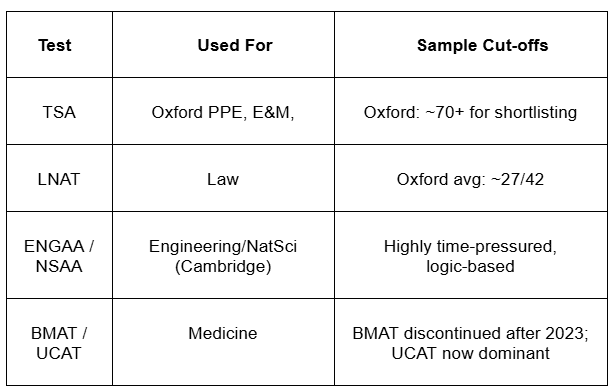
These tests are designed to differentiate at the top end. That means they include trick questions, abstract reasoning, and tight time limits.
For each student, we identify test requirements by April, and prep begins over summer with:
- Past paper drills (going back 5+ years)
- Section-specific techniques (e.g., TSA Problem Solving ≠ SAT Math)
- Performance tracking to estimate risk level (we’ve benchmarked scores vs offer rates)
4. Oxbridge Interviews – They’re Testing How You Think, Not What You Know
If you’re shortlisted by Oxford or Cambridge, you’ll be invited to interview in early December. Each interview lasts ~25 minutes and feels like a supervision/tutorial.
It’s not about confidence or prior knowledge. It’s about being teachable and logical under pressure.
Some real questions our students have faced:
- Oxford Law: “Should freedom of speech include the right to lie?”
- Cambridge Econ: “Why do you always see petrol stations built beside one another?”
- Oxford History: “Here’s a medieval manuscript excerpt — what can you infer about its author?”
What we do:
- Simulate real interviews (college specific where possible)
- Train students to “think aloud” and show their reasoning
- Provide debriefs and frameworks to avoid classic traps (e.g., freezing, second-guessing)
You’re not being quizzed. You’re being invited into a conversation and how you handle uncertainty is everything.
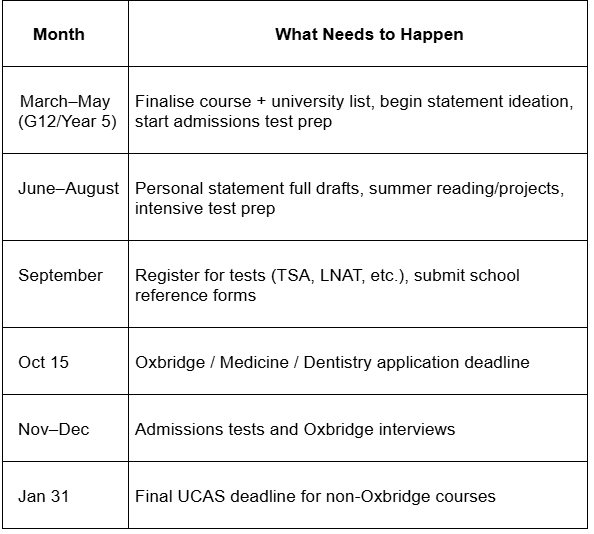
5. Timeline: When to Start (And When It’s Already Too Late)
Here’s how we structure the year:
How We Help
We don’t run generic programs. Every student gets a bespoke G5 plan, guided by mentors who’ve actually been through the process.
What’s included:
- Course + uni selection advisory
- Unlimited edits on personal statement questions
- Subject-specific test prep (with diagnostic scoring + feedback)
- Portfolio building (research, competitions)
- 1:1 mock interviews with Oxbridge grads
- Mentorship from subject specialists
Want to Work With Our G5 Strategy Team?
Our admissions team is led by Oxbridge grads, IB Examiners, and test specialists.
If you’re aiming for a G5 offe:
Book a consultation to learn more about our G5 Full Support Programme start to offer support.