Most families in Singapore apply to both the US and the UK, and run the same strategy at both. That is the single most expensive mistake in this process, because the two systems are not looking for the same student. This guide covers how each one works, what the current numbers actually are, when everything falls on the calendar, and how your IB Diploma is read at either end.
The difference that shapes everything else
A UK application is an application to a course. You apply to read Economics, and the people reading your file are the academics who will teach you Economics. They want evidence you can do that subject at university level, and almost nothing else. Your sports captaincy is close to irrelevant.
A US application is an application to an institution. You apply to the university, often without declaring a major that binds you, and the people reading your file are professional admissions officers assembling a class. They want to know who you are, what you’ve built, and what you’d add to campus. Your academic record gets you into the room; the rest of the file decides what happens there.
Run one strategy for both and you’ll produce a UK application cluttered with achievements nobody asked about, and a US application that reads like a transcript with a covering note.
The UK route: how UCAS actually works
Five choices, one form. You submit a single application listing up to five courses, and every university sees the same personal statement. You cannot apply to both Oxford and Cambridge in the same cycle. Medicine, dentistry and veterinary science are capped at four choices.
Two deadlines. For 2027 entry, applications to Oxford, Cambridge, medicine, dentistry and veterinary science close at 6pm UK time on 15 October 2026. The equal consideration deadline for everything else is 13 January 2027. Your school’s internal deadline for the reference will be earlier than both, sometimes by several weeks.
The personal statement has changed. From 2026 entry, it is three structured questions rather than one free-form essay, totalling 4,000 characters with a minimum of 350 per section. The questions cover why you want to study the subject, how your qualifications and studies have prepared you, and what you have done outside education that is relevant. If you are working from an older guide or an older sibling’s draft, you are working from the wrong format.
Predicted grades do the heavy lifting. You apply before you sit your IB exams, so your teachers’ predictions are what universities actually assess. Those predictions come from work you have already submitted, which means the ceiling on your application was set months before you started writing it.
Admissions tests have been overhauled
This is the change most likely to catch out anyone using last year’s information. In January 2026, Oxford discontinued eight of its own tests, including the PAT, MAT and TSA, replacing them for 2027 entry with three shared tests run by UAT-UK: ESAT, TMUA and TARA. Cambridge and Imperial already used ESAT and TMUA, and UCL is adopting TARA.
Registration accounts opened on 1 June 2026, booking opened on 20 July, and booking closes on 28 September 2026. LNAT registration opened on 1 August. The October sitting runs 12–16 October 2026 and applies to all 2027-entry candidates, and Oxford and Cambridge applicants must sit in October rather than the January window.
Medicine still uses the UCAT and Law still uses the LNAT, neither of which changed. But note that the UCAT itself was restructured recently: Abstract Reasoning was withdrawn and the total is now out of 2,700 rather than 3,600.
The UK numbers
For students starting in 2025/26, Oxford’s acceptance rate was 14.2 percent and Cambridge’s was 16.3 percent. Those headline figures hide enormous variation: Oxford Economics and Management admitted 5.1 percent of applicants, Cambridge Computer Science 7.4 percent.
Two things follow for a Singapore applicant. First, course choice moves your odds far more than college choice does. Second, the international pool is tougher than the headline: in 2024, international applicants to Cambridge had an acceptance rate of about 10.9 percent, against roughly 19.7 percent for UK applicants.
That said, Singapore performs unusually well among international applicant pools at Cambridge, with country-level success rates reported well above the international average in recent cycles. Figures move year to year, so check Cambridge’s own published undergraduate admissions statistics rather than trusting a summary.
After you apply. Shortlisting happens in November, Oxbridge interviews run in December, and offers arrive in January. Cambridge also runs a winter pool, which redistributes strong applicants who missed out at their first-choice college.
The US route: how the Common App actually works
One platform, many applications. The Common App opens on 1 August each cycle. You complete one core application and then a separate set of supplemental essays for almost every university on your list. The supplements are where most of the real work sits, and where most applicants run out of time.
Volume is the story. The Common App processed over 8 million submissions in the 2025–26 cycle, up from 7.1 million the year before. Class sizes have not moved. That arithmetic is most of why acceptance rates keep falling.
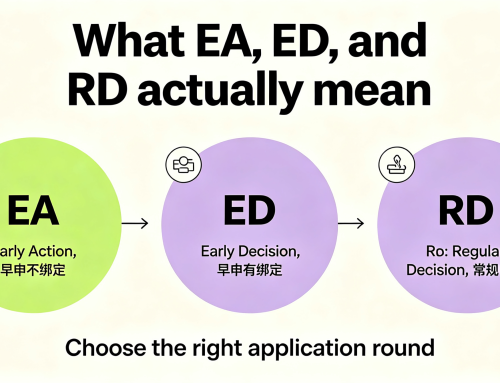
Rounds matter. Early Decision is binding and usually due 1 November; Early Action is non-binding on a similar date; Regular Decision is usually 1 January, though some universities use 5 January. Several highly selective universities now fill 40 to 50 percent of their incoming class through Early Decision, which changes the calculus considerably. We’ve covered this in more detail in our guide to what EA, ED and RD actually mean.
The written components. A 650-word personal essay chosen from set prompts, an activities list capped at ten entries of 150 characters each, and supplements that typically ask why this university and why this field. Teacher and counsellor recommendations sit alongside these, which is why the relationship with the teachers who will write for you matters more than students assume.
Testing is back
The test-optional era is effectively over at the top of the US system, and the timing is confusing because schools switched in different years.
For the 2026–27 cycle, six of the eight Ivies require the SAT or ACT: Harvard, Yale, Dartmouth, Brown, Cornell and Penn. Princeton announced in October 2025 that it would require testing from the 2027–28 cycle, and Columbia announced in June 2026 that it would do the same. Princeton remains test optional for applicants seeking to enrol in fall 2026 or fall 2027.
So if you are applying this cycle, two Ivies are still test-optional. If you are a year behind, none are. Stanford, MIT and Caltech have also restored requirements.
The US numbers
For the Class of 2030, Yale admitted 2,328 students from 54,919 applicants, an acceptance rate of 4.24 percent, down from 4.75 percent the previous cycle. Columbia admitted 4.23 percent. Brown admitted 5.35 percent. MIT reported 4.6 percent, admitting 1,299 from 28,349 applications.
Read those with one caveat. Harvard, Princeton, Penn, Dartmouth and Cornell released little or no official data for this cycle, citing disclosure policy changes following the 2023 Supreme Court decision on affirmative action, so any figure you see quoted for those schools is an estimate.
The honest reading of a 4 percent acceptance rate is not “I have a 4 percent chance”. It is that the pool has already self-selected heavily, almost everyone in it is academically qualified, and the decision is being made on everything else.
What each system does with your IB Diploma
UK offers are conditional and specific. You will be asked for a total and for named HL grades, typically something like 40 points with 776 at HL for the most competitive courses, and the HL requirement is usually the harder half. Miss the HL condition with the right total and the offer can still fall.
US universities read the IB Diploma as evidence of curriculum rigour rather than as a threshold. There is no published cut-off. Most competitive US universities grant credit or advanced standing for HL scores of 6 or 7, though the policy varies by institution and sometimes by department, so check individually rather than assuming.
Neither system sees your internal assessments or reads your Extended Essay. The influence runs through your predicted grades and through what you can write and say about that work. A student who chose an EE question in the subject they intend to read has material for the second UCAS question and for a US supplement, and something substantive to defend at an Oxbridge interview.
The full timeline
Dates below are for 2027 entry. Shift by a year for later cycles and check the current published dates, since several of these have moved recently.
- June–July 2026 — Shortlist courses and universities. UAT-UK accounts open 1 June; booking opens 20 July. Register for the UCAT if you are applying to medicine.
- 1 August 2026 — Common App opens. Start the 650-word essay now, not in October.
- August–September 2026 — Draft the UCAS three-question statement. Ask teachers for references and give them something concrete to work from. UCAS submission opens 1 September.
- 28 September 2026 — UAT-UK booking closes. This is a hard stop.
- 12–16 October 2026 — ESAT, TMUA and TARA sitting for all Oxbridge candidates.
- 15 October 2026 — UCAS deadline for Oxford, Cambridge, medicine, dentistry, veterinary science.
- Early November 2026 — Most US Early Decision and Early Action deadlines.
- November 2026 — Oxbridge shortlisting; interview invitations issued.
- December 2026 — Oxbridge interviews. US early decisions released mid-month.
- 1 January 2027 — Most US Regular Decision deadlines.
- January 2027 — Oxford offers around mid-month, Cambridge later, plus the Cambridge winter pool.
- 13 January 2027 — UCAS equal consideration deadline for all remaining courses.
- Late March 2027 — US Regular Decision results, including Ivy Day.
- 1 May 2027 — US commitment deadline.
- May 2027 — IB final examinations.
- Early July 2027 — IB results; UK offers confirmed; Clearing opens.
If you sit the November session, this timeline compresses badly. Your final exams land in November, results arrive in early January, and the UCAS equal consideration deadline follows within days. A 15 October application means drafting a personal statement during study leave. Everything here needs to start earlier for you than it does for a May candidate.
Applying to both, without wrecking either
It is entirely doable, and most Singapore students at this level should. Three things to plan for.
The October and November crunch is real. Oxbridge admissions tests, the 15 October UCAS deadline and US early deadlines all sit inside a five-week window, in the same term your school is running mocks.
Your writing does not transfer. The UCAS statement is an argument that you can do this subject; the Common App essay is a piece of personal narrative. Repurposing one as the other produces a weak version of both, and admissions readers on either side recognise it immediately.
Your subject choices constrain you. UK courses ask for specific HL subjects, sometimes at specific grades, and those requirements are set before you apply. If Cambridge Engineering and a US liberal arts route are both on the table, the HL combination has to satisfy the more restrictive of the two. That decision gets made at the start of the IB Diploma, not at the start of the application.
The questions we hear most
“Should we apply to more universities to improve the odds?” In the UK, no. You have five choices, and adding a course you don’t want to read is wasted. In the US, a longer list helps only if each supplement is written properly, which is the constraint most families underestimate. Twelve well-researched applications beat twenty rushed ones.
“Does Early Decision genuinely help?” Statistically yes at many universities, because a large share of the class is filled early. But it is binding, and it removes your ability to compare financial aid offers. It only makes sense when you are certain about the school and the cost.
“Our child has strong grades but a thin activities record. Which system?” The UK, comfortably. A UK application can be carried by academic evidence: subject knowledge, the admissions test, the interview. A US application with a thin file outside academics struggles at the top end regardless of scores.
“How much do the interviews matter at Oxbridge?” A great deal, and they are not tests of knowledge. Interviewers give you an unfamiliar problem and watch how you reason through it, including how you respond to being corrected. Students who prepare by memorising answers tend to do worse than students who practise thinking aloud.
“Is it too late to start if we’re already partway through the IB?” No, but the sequence changes. Focus on what is still moveable — predicted grades, admissions test preparation, the quality of your written components — rather than trying to manufacture a portfolio in the final term. A short project you can discuss in real detail beats a long list you cannot.
One last thing
The families who find this process manageable are not the ones with the most impressive children. They’re the ones who understood the two systems as genuinely different exercises, decided early which HL subjects would keep both doors open, and started the writing while there was still time to make it good.
Everything on the timeline above is published years in advance. None of it is a surprise unless you let it be.
How we help you through US and UK applications
We don’t just proofread essays; we work on the strategy that determines what those essays can say. Our services include:
- Course and subject strategy: Choosing HL and SL subjects that satisfy UK course requirements while keeping US options open, planned from the start of the IB Diploma.
- Admissions test preparation: ESAT, TMUA, TARA, UCAT, LNAT and SAT/ACT, taught by tutors who have sat the current versions.
- Written components: The three-question UCAS statement and the Common App personal essay and supplements, developed as two distinct pieces of work.
- Interview preparation: Oxbridge-style problem interviews and US alumni interviews, practised until thinking aloud feels normal.
- Portfolio and profile building: Research supervision, project mentorship and a realistic activity plan mapped to your target courses.
Reach us at enquiries@qeducation.sg or book a consultation through our website.
Quintessential is the leading specialist in Oxbridge and Ivy League applications in Singapore. Call us today on (+65) 6100 9338 to find out how our personalised admissions counselling can support your application journey.